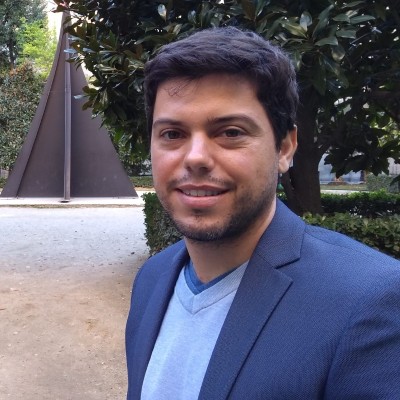
Guilherme Henrique Favaro Fuzato
Professor of Power Electronics, UNICAMP/FEEC
About
He received the B.S. degree in Electrical Engineering in 2011 from the University of São Paulo, São Carlos, Brazil, where he also received the M.S. and Ph.D. degrees in Electrical Engineering in 2015 and 2019, respectively. From 2018 to 2019, he was a Visiting Researcher at Aalborg University, Aalborg, Denmark.
He worked as a Field Service Engineer at Siemens from 2012 to 2013, and as an R&D Engineer at Robert Bosch Ltda./IEL/CNPq under the InovaTalentos Fellowship from 2014 to 2015. From 2016 to 2025, he served as an Assistant Professor at the Federal Institute of Education, Science and Technology of São Paulo, Campinas, Brazil.
He is currently an Assistant Professor at the Faculty of Electrical and Computer Engineering (FEEC) at the University of Campinas (UNICAMP), Campinas, Brazil. His research interests include microgrids, energy management, and DC–DC converters for renewable energy and energy storage systems.
Five Main Publications
The updated and full list of publications can be found at my Google Scholar profile .
This article presents a comprehensive review of energy management strategies (EMS) applied to state-of-charge balancing in Battery Energy Storage Systems (BESS) integrated into microgrids.
View paperThis article proposes the Droop k-Sharing technique, which enables coordination of sources with different dynamic responses, such as fuel cells and batteries, and regulates their power contributions to the DC bus without fast communication.
View paperThis article presents an adaptive control method to coordinate sources with different dynamic responses, such as fuel cells and batteries, as well as their power contributions to the DC bus. Unlike the technique presented in “Droop k-Sharing Function for Energy Management of DC Microgrids”, this approach relies on coupled control loops that require fast communication among the controllers of each source.
View paperThis work proposes a redundant DC microgrid architecture accompanied by a control strategy for state-of-charge balancing of resilient Battery Energy Storage Systems (BESS). The architecture is based on redundantly organized DC-DC converters, employing a charge-equalization technique capable of operating even during converter failures or maintenance.
View paperThis study investigates the effect of parasitic resistances of passive components and load demand on converter voltage gain. It determines the operating boundaries of the Interleaved Boost with voltage multiplier through mathematical modeling and graphical analysis. The work is relevant to fuel cell interfaces, which demand high voltage gain and the ability to process high input current.
View paperResearch Funding
Role: Principal Researcher
Period: 06/2024 – 07/2025
Role: Associate Researcher
Period: 2019 – 2021
Role: Associate Researcher
Period: 2015 – 2018
Role: Associate Researcher
Period: 2015 – 2017
Main Teaching Courses
-
Course EE833 – Power Electronics
Undergraduate – UNICAMP/FEEC. -
Course IT505 – Switch Mode Power Supplies
Graduate – UNICAMP/FEEC.
Prizes and Recognitions
-
Best Paper Award in Latin America – Typhoon HIL (2025)
Co-supervisor of the first author (Thales Fagundes), awarded for the paper:
“Economic Operation Optimization Under Real-Time Pricing for an Energy Management System in a Redundancy-Based Microgrid” -
Outstanding Paper Prize – IEL / CNPq / Robert Bosch Ltda. (2016)
Analysis and Implementation of Protection Techniques Against Reverse Polarity for High-Power Density Automotive Applications
Análise e Implementação de Técnicas de Proteção Contra Reversão de Polaridade para Aplicações Automotivas de Alta Densidade de Potência
Professional Memberships
-
IEEE Member – #91246617
South Brazil Section; Industrial Electronics Society; Power Electronics Society; Young Professionals -
SOBRAEP Member
Sociedade Brasileira de Eletrônica de Potência
Contact
Email: fuzato@unicamp.br
Address: Av. Albert Einstein, Nº 400 - Cidade Universitária, 13083-852
Office: 205A, Building A 1º Floor, FEEC, UNICAMP, Campinas, Brazil.